
If you’re expanding your business abroad, applying for a visa, enrolling in an overseas university, or closing an international deal, chances are you’ll be asked for “consular legalization” of your documents. But what does that actually mean and why is it sometimes required even after notarization?
While the process can seem complex, understanding how it works and when it’s required can save time, prevent costly delays, and ensure your international transactions move forward smoothly.
In this article, we provide a comprehensive guide to the procedures for legalizing foreign documents for use in Vietnam and Vietnamese documents for use abroad. We’ll walk you through what consular legalization involves and what you need to prepare to ensure your documents are properly recognized and accepted.
What is consular legalization?
Consular legalization is the official process of verifying and certifying foreign documents so they can be legally recognized in another country. It involves confirming the authenticity of the document’s signature, the capacity of the person who signed it, and the seal or stamp of the issuing authority.
Purpose:
- To ensure documents are lawful, authentic, and not forged
- To help receiving authorities in another country trust and accept the documents
*Note: Consular legalization does not certify the content of the documents; it only certifies the validity of the signature, seal, and the title of the signatory.
When is consular legalization required?
Consular legalization is required when the country where the document will be used is not a member of the Hague Apostille Convention, or when one of the two countries involved does not participate in the Apostille system.
Example: Since Vietnam is not a member of the Hague Apostille Convention, a foreigner applying for a work permit in Vietnam must legalize their diploma issued abroad in order for it to be legally recognized in Vietnam.
If both countries are members of that convention, a simpler apostille certificate replaces the multi-step legalization process.
Common documents requiring consular legalization
- Birth certificate
- Marriage certificate
- Certificate of single status
- Criminal record certificate
- Diplomas
- Academic transcripts
- Certificates
- Business registration certificate
- Company charter
- Contracts
Consular legalization procedures
Before beginning the consular legalization process, it is important to confirm whether your documents actually require legalization. This can be done by contacting the embassy or the competent authority of the country where the documents will be used.
Once you have verified that legalization is required, you may proceed with the application. The specific steps will vary slightly depending on whether the documents were issued in Vietnam or issued abroad.
Consular legalization of foreign documents for use in Vietnam
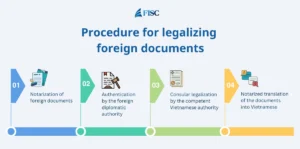
Step 1: Authentication by the issuing country
The document must first be authenticated by the competent authority in the country where it was issued (such as a notary public or relevant government authority). This step verifies the authenticity of the signature and seal on the document.
Step 2: Certification by the Embassy or Consulate of the issuing country
After authentication, the document must be certified by the appropriate diplomatic mission of the issuing country. The procedure depends on where the applicant is residing:
- If residing abroad: Certification is carried out at the competent diplomatic authority of the issuing country in that country.
- If residing in Vietnam: Certification is completed at the Embassy or Consulate of the issuing country in Vietnam.
Step 3: Consular legalization by the Vietnamese authorities
Once the previous steps have been completed, you must submit your documents to the competent Vietnamese authority for consular legalization.
Your application dossier typically includes:
- An application form for consular certification/legalization
- Your original identification document (passport or national ID card)
- The original document to be legalized, together with a copy (already certified by the consular office or diplomatic mission of the issuing country)
- The original and a copy of the translation (if the document is not in Vietnamese or English)
*Note: If the document consists of two or more pages, it must be bound and stamped with a seal across the pages.
After preparing a complete dossier, you may submit it to the Ministry of Foreign Affairs of Vietnam or an authorized Department of Foreign Affairs to complete the consular legalization procedure, allowing the document to be legally used in Vietnam.
Step 4: Notarized translation
Following consular legalization, the document is typically required to be translated into Vietnamese and the translation notarized, depending on the requirements of the receiving authority.
Consular legalization of Vietnamese documents for use abroad
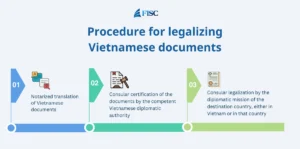
Step 1: Notarized translation
The document must be translated into English or into the official language of the country where it will be used. The translation must then be notarized at a competent notary office in Vietnam.
Step 2: Consular certification by Vietnamese authorities
After notarization, the document must be submitted for consular certification by the competent Vietnamese authority.
Required documents typically include:
- An application form for consular certification/legalization
- Your original identification document (passport or national ID card)
- Original and a copy of the document to be certified
- Original and a copy of the translated document
Where to submit:
- In Vietnam: The Consular Department of the Ministry of Foreign Affairs in Hanoi or the Department of Foreign Affairs in Ho Chi Minh City
- Abroad: The Vietnamese diplomatic mission or other authorized authority in the host country
Step 3: Consular legalization by the destination country
Once the document has been certified by Vietnamese authorities, it must be submitted to the competent authority of the country where it will be used for consular legalization.
Depending on the destination country, this may be:
- The embassy or consulate of that country in Vietnam, or
- The competent foreign affairs authority of that country within its own territory
After completing these steps, the document will generally be recognized for legal use in the destination country.
Where to apply for consular legalization in Vietnam?
For individuals residing in Vietnam, applications may be submitted either in person or by post to the following authorities:
- Hanoi: Consular Department – Ministry of Foreign Affairs (40 Tran Phu Street, Dien Bien Ward, Ba Dinh District)
- Ho Chi Minh City: Department of Foreign Affairs of Ho Chi Minh City (6 Alexandre de Rhodes Street, Ben Nghe Ward, District 1)
- Other provinces: Local Departments of Foreign Affairs authorized by the Ministry of Foreign Affairs to receive applications for consular certification and legalization
For individuals residing abroad:
- The Embassy or Consulate General of Vietnam in the host country
Frequently asked questions
How long does consular legalization in Vietnam take?
In most cases, consular legalization is processed within two working days from the date the competent authority receives a complete and valid application.
If the dossier contains 10 or more documents, the processing time may be extended but will not exceed five working days. For applications submitted by post, the total processing time may take up to 10 working days, depending on delivery times.
Can Vietnam’s consular legalization be completed online?
Under Decree No. 111/2011/ND-CP and Circular No. 01/2012/TT-BNG issued by the Ministry of Foreign Affairs, consular legalization in Vietnam cannot be completed entirely online.
However, Vietnamese citizens may fill out the application form and pay the applicable fees online through the National Public Service Portal. The physical documents must still be submitted to the competent authority for processing.
Can I authorize someone else to submit the application?
Yes. Both individuals and organizations may authorize another person to submit an application for consular certification or legalization on their behalf. The authorized representative must provide a signed power of attorney or letter of authorization, and a valid identification document.
What’s the difference between consular legalization and apostille certification?
Consular legalization is required when the destination country is not a member of the Convention. The document must go through multiple steps, including government authentication and legalization by the relevant embassy or consulate.
Apostille certification, on the other hand, applies when both the issuing and destination countries are members of the Hague Apostille Convention. In this case, the document only requires a single apostille issued by a designated authority in the country of origin. Once attached, it is recognized in all member countries without further embassy legalization, making the process faster and simpler.
Reliable consular legalization services for international use
Consular legalization is an essential step to ensure that Vietnamese documents are officially recognized abroad and that foreign documents can be legally used in Vietnam. However, the process can sometimes be complex, especially for busy individuals or those handling it for the first time.
To make the process smoother and more efficient, choosing a reputable consular legalization service provider is the optimal solution. With nearly 40 years of experience, FISC proudly delivers professional, dedicated, and effective consular legalization services. Contact us today for detailed consultation.