
For foreign workers in Vietnam, a work permit is typically one of the key requirements to legalize employment. However, to facilitate investment and attract high-quality talent, the government has introduced exemptions for certain cases.
So, who is eligible for a Vietnam work permit exemption, and what conditions apply? Do foreign workers still need to complete any confirmation procedures with the authorities? In this article, FISC provides a detailed overview of Vietnam work permit exemption cases, required supporting documents, and the process to help businesses implement smoothly and remain fully compliant.
Who is eligible for Vietnam work permit exemption?
Article 154 of the 2019 Labor Code and Article 7 of Decree 152/2020/ND-CP specify 20 cases in which foreign workers may qualify for a Vietnam work permit exemption, including:
Managers and executives
1. Owners or capital-contributing members of a limited liability company (LLC) with a capital contribution of VND 3 billion or more.
2. Chairpersons or members of the Board of Directors of a joint-stock company with a capital contribution of VND 3 billion or more.
3. Heads of representative offices, projects, or individuals primarily responsible for the operations of international organizations or foreign non-governmental organizations (NGOs) in Vietnam.
4. Individuals responsible for establishing the commercial presence of foreign enterprises in Vietnam.
5. Those working for less than 30 days in managerial, executive, expert, or technical positions (limited to a maximum of 3 times per year).
Short-term or project-based workers
6. Entering Vietnam for less than 3 months to offer services.
7. Entering Vietnam for less than 3 months to handle complex technical or technological issues that affect or risk affecting production, which cannot be resolved by Vietnamese experts or foreign experts currently in Vietnam.
8. Participating in ODA-funded projects under international agreements.
9. Intra-company transferees within 11 service sectors under Vietnam’s WTO commitments, including: business, information, construction, distribution, education, environment, finance, healthcare, tourism, culture and entertainment, and transportation.
10. Providing professional or technical consultancy, or performing other tasks related to research, development, appraisal, monitoring, evaluation, management, and implementation of programs or projects using Official Development Assistance (ODA), in accordance with regulations or international agreements signed between Vietnam and foreign authorities.
Education and training
11. Students studying at overseas educational institutions who have internship agreements with agencies, organizations, or enterprises in Vietnam; trainees or apprentices working on Vietnamese seagoing vessels.
12. Individuals assigned by competent foreign authorities to Vietnam for teaching or research at international schools managed by foreign diplomatic missions or the United Nations, or at institutions established under international agreements to which Vietnam is a signatory.
13. Foreign workers certified by the Ministry of Education and Training to enter Vietnam for teaching or research purposes.
Diplomatic & volunteer activities
14. Individuals granted a license by the Ministry of Foreign Affairs to carry out information and press activities in Vietnam in accordance with the law.
15. Individuals entering Vietnam to implement international agreements signed by central or provincial-level agencies and organizations in compliance with legal regulations.
16. Volunteers working under international agreements, with certification from foreign diplomatic missions in Vietnam.
17. Family members of staff of foreign diplomatic missions in Vietnam who are permitted to work.
18. Holders of official passports working for state agencies or socio-political organizations.
Other cases
19. Foreign nationals who are married to Vietnamese citizens and residing in Vietnam.
20. Foreign lawyers who have been granted a license to practice law in Vietnam.
*Note:
- For cases that do not qualify for a Vietnam work permit exemption, both the employer and the foreign worker must proceed with applying for a work permit or renewing an existing one, depending on the current permit status and employment needs in Vietnam.
- In cases where the work permit is lost, damaged, or the passport number has changed, the foreign worker must apply for a re-issuance of the work permit.
Is it required to declare Vietnam work permit exemption cases?
Even if a foreign worker is exempt from a work permit, the employer is still required to carry out the work permit exemption confirmation procedure. According to regulations, at least 10 days before the employee’s expected start date, the company must submit a request to the Department of Labor, Invalids and Social Affairs (DOLISA) in the locality where the employee is expected to work.
The process includes the following steps:
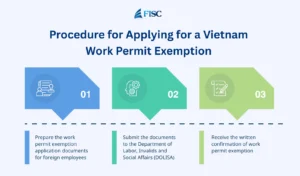
Step 1: Prepare the Vietnam work permit exemption dossier
Pursuant to Article 8 of Decree 152/2020/ND-CP, foreign investors and experts applying for a Vietnam work permit exemption confirmation must prepare the following documents:
– Application form requesting confirmation that the foreign worker is not subject to a work permit requirement
– Health certificate valid within the last 12 months
– Approval letter for the demand to employ foreign workers
– Certified copy of the passport
– Supporting documents proving that the foreign worker is eligible for work permit exemption
- Investors/owners/board members/managers: Investment registration certificate, enterprise registration certificate of the foreign-invested company, company charter, appointment decision
- Foreign workers working for less than 3 months: Short-term employment contract or documents proving the working duration
- Intra-company transferees: Confirmation letter from the parent company and internal transfer decision
- Foreigners married to Vietnamese citizens: Marriage certificate
- …
*Note:
- For foreign workers specified in Clauses 3, 4, and 5, Article 154 of the Labor Code and Clauses 1, 2, 8, 9, 10, 11, 12, and 13, Article 7 of Decree 152/2020/ND-CP, employers are not required to obtain approval for the demand to employ foreign workers.
- Documents issued by foreign authorities or organizations must be translated into Vietnamese, consular legalized, and notarized in accordance with regulations.
Step 2: Submit the application
After preparing a complete dossier, the company submits it to the DOLISA where the foreign worker is expected to work.
*Note: In some localities such as Ho Chi Minh City, the receiving authority has been merged into the Department of Home Affairs under a new administrative structure. Therefore, businesses should verify the correct authority and official name of the receiving body in the relevant locality before submission.
Step 3: Receive the result
DOLISA will review and process the application. If the dossier is valid, the company will receive a written confirmation of Vietnam work permit exemption within 5 working days.
*Note: For cases specified in Clauses 4, 6, and 8, Article 154 of the Labor Code and Clauses 1, 2, 8, and 11, Article 7 of Decree 152/2020/ND-CP, it is not required to apply for work permit exemption. However, the employer must report to DOLISA at least 3 days prior to the employee’s expected start date, including the following information:
- Full name
- Nationality
- Passport number
- Employer’s name
- Employment start and end dates
Validity of Vietnam work permit exemption certificate for foreigners
According to regulations, the confirmation certificate stating that a foreign worker is not subject to a work permit is valid for a maximum of 2 years.
In practice, the validity period of a Vietnam work permit exemption certificate depends on the duration of the employment contract, the term of the position, or the assignment period of the foreign worker.
Once the certificate expires, the foreign worker must either reapply for a work permit exemption confirmation or apply for a new work permit if they wish to continue working in Vietnam.
Will companies be penalized for not applying for Vietnam work permit exemption?
Yes. Under Article 31 of Decree No. 28/2020/ND-CP, failure to carry out the required Vietnam work permit exemption confirmation procedure may result in the company being deemed to employ foreign workers without a valid permit, even if they are eligible for exemption.
For foreigners
Foreign workers may face fines ranging from VND 15,000,000 to VND 25,000,000 if they work without a valid Vietnam work permit exemption confirmation or use an expired confirmation document.
For employers
Companies employing foreign workers without a valid Vietnam work permit exemption confirmation, or using expired confirmation documents, may be subject to the following penalties:
- Violations involving 1 to 10 employees: VND 30,000,000 – VND 45,000,000
- Violations involving 11 to 20 employees: VND 45,000,000 – VND 60,000,000
- Violations involving 21 or more employees: VND 60,000,000 – VND 75,000,000
Vietnam work permit exemption services for foreigners
Work permit exemptions offer significant advantages for investors, experts, and foreign-invested businesses operating in Vietnam. However, to ensure proper application and minimize legal risks, companies must clearly understand eligible cases, prepare complete supporting documents, and follow the required procedures for exemption confirmation.
If your company is planning to hire foreign executives, experts, or investors in Vietnam, assessing eligibility for work permit exemption and preparing compliant documentation is a crucial step. With 40 years of experience in international investment consulting, FISC provides comprehensive legal solutions to help businesses complete procedures quickly, accurately, and efficiently. Contact FISC today for end-to-end consultation and support.