

Having a thriving economy, strategic location, and business-friendly policies, Vietnam has emerged as one of Asia’s most attractive investment destinations, drawing entrepreneurs, business owners, and investors from around the world. To support foreign investment, Vietnam offers a dedicated investment visa designed specifically for investors and business stakeholders.
But what exactly is a Vietnam investment visa, who qualifies, and how can you apply successfully? In this guide, we’ll walk you through everything you need to know, from key benefits, eligibility requirements to visa types and application procedures, so you can confidently take the next step toward investing in Vietnam.
What is a Vietnam investment visa?
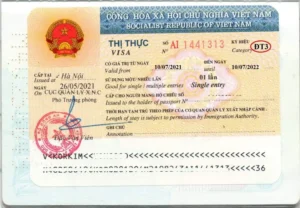
A Vietnam investment visa allows foreign nationals to enter, reside, and carry out investment activities in Vietnam. It is typically granted to:
- Legal representatives of foreign-invested companies in Vietnam
- Foreign investors who contribute capital to joint ventures or wholly foreign-owned enterprises
Under Vietnamese immigration law, investment visas are issued under the DT visa category and is part of the current Vietnamese visa system.
If an investor plans to come to Vietnam for a short period to conduct market research, meet partners, or explore business opportunities, they may consider applying for an electronic visa (e-visa) first. With a maximum validity of 90 days, this option is more suitable for the initial exploration stage, allowing the investor to enter Vietnam more conveniently before deciding to proceed with long-term investment procedures.
What benefits does a Vietnam investment visa offer?
Holding a Vietnam investment visa provides foreign investors with several important benefits, including:
- Legal residency in Vietnam throughout the visa’s validity period
- Eligibility to renew the visa upon expiration, provided all legal requirements continue to be met
- The ability to apply for an investment temporary residence card (TRC) valid for up to 10 years for DT1, DT2, and DT3 visa holders
- The right to sponsor a spouse and children for dependant visas, applicable to holders of DT1, DT2, and DT3 visas
Types of Vietnam investment visas
Under Law No. 51/2019/QH14, Vietnam’s investment visa is divided into four categories, each with a different validity period based on the investor’s capital contribution or the nature of the investment project.
| Visa Type | Eligible Applicants | Maximum Validity |
| DT1 | Foreign investors and representatives of foreign organizations investing in Vietnam with a capital contribution of VND ≥ 100 billion OR investing in industries or locations eligible for investment incentives as determined by the Vietnamese Government. | Up to 5 years |
| DT2 | Foreign investors and representatives of foreign organizations investing in Vietnam with a capital contribution from VND 50 billion to under VND 100 billion OR investing in sectors encouraged by the Vietnamese Government. | Up to 5 years |
| DT3 | Foreign investors and representatives of foreign organizations investing in Vietnam with a capital contribution from VND 3 billion to under VND 50 billion. | Up to 3 years |
| DT4 | Foreign investors and representatives of foreign organizations investing in Vietnam with a capital contribution of less than VND 3 billion. | Up to 1 year |
Requirements for obtaining a Vietnam investment visa
To qualify for a Vietnam investment visa, foreign investors must meet the following requirements:
- Hold a valid passport in accordance with Vietnamese regulations.
- Be sponsored by a company, organization, or agency legally operating in Vietnam.
- Provide documents proving their legal investment status, such as:
- Business registration certificate or investment registration certificate
- Capital contribution certificate in a Vietnamese company
- Other valid documents demonstrating investor eligibility under Vietnamese law
How to apply for a Vietnam investment visa
The application process varies depending on whether the foreign investor is currently outside Vietnam or already residing in the country.
Applying from outside Vietnam
Foreign investors applying from abroad typically follows these three steps:
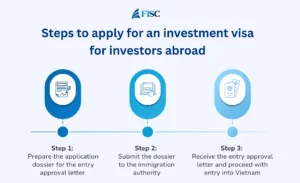
Step 1: Prepare the entry approval application
The sponsoring company in Vietnam, where the investor has contributed capital or made an investment, must prepare and submit the application dossier, including:
- Seal and signature registration form of the company’s legal representative
- Certified copy of the enterprise registration certificate, investment registration certificate, or establishment decision issued by the competent authority
- Certified copy of the foreign investor’s passport
- Notarized copy of the investment certificate (if applicable)
- Entry sponsorship letter
Step 2: Submit the application
Once the dossier is complete, the sponsoring company submits it to one of Vietnam’s Immigration Departments:
- Ho Chi Minh City Immigration Department: 333–335–337 Nguyen Trai Street, District 1, Ho Chi Minh City
- Hanoi Immigration Department: 44–46 Tran Phu Street, Ba Dinh District, Hanoi
- Da Nang Immigration Department: 78 Le Loi Street, Hai Chau District, Da Nang
Step 3: Receive the entry approval letter and enter Vietnam
If the application is approved, the Immigration Department will issue a receipt and process the application within approximately five working days. Once approved, an entry approval letter will be issued, allowing the investor to obtain the visa and enter Vietnam.
The sponsoring company will send the entry approval letter to the investor, who can then proceed with visa stamping before entering Vietnam.
Upon arrival, the foreign investor must prepare the following documents:
- Original passport with sufficient validity and at least two blank pages
- Two 4×6 cm passport photos with a white background
- A printed copy of the entry approval letter
- A completed visa application form for submission at the port of entry or Vietnamese diplomatic mission
Depending on the location specified in the entry approval letter, the investor may obtain the visa either at a Vietnamese Embassy or Consulate in their home country, or upon arrival at one of Vietnam’s international ports of entry.
Applying from within Vietnam
Foreign investors already in Vietnam under another visa type, such as a tourist or business visa, may apply to convert their current visa to an investment visa.
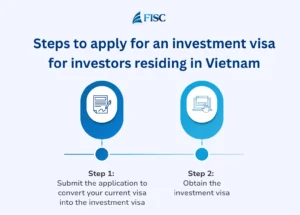
Step 1: Submit the application
The sponsoring company must prepare and submit the following documents:
- Seal and signature registration form of the company’s legal representative
- Notarized copy of the enterprise registration certificate or investment registration certificate
- Notarized copy of the investment certificate, if applicable
- Original passport and the investor’s current valid visa or temporary residence card
- Visa issuance or temporary stay extension application form
- Temporary residence registration confirmation issued by the local police
The completed application should be submitted to the Immigration Department responsible for the area where the sponsoring company is registered.
Step 2: Receive the investment visa
After submission, the sponsoring company will receive an appointment slip and return on the scheduled date to collect the result. Once approved, the investor will be granted a Vietnam investment visa, allowing them to reside legally in Vietnam for the duration specified on the visa.
Secure your Vietnam investment visa with expert guidance
The Vietnam investment visa is your gateway to establishing and growing your business in one of Asia’s most dynamic markets. By selecting the right visa category based on your investment amount and business goals, you can maximize your benefits while ensuring a seamless experience living and investing in Vietnam.
If you need professional assistance on document preparation and application procedures, FISC is here to help. With more than 40 years of experience supporting thousands of foreign investors and international businesses across diverse industries, we provide fast, accurate, and tailored solutions for every client. Contact our team today to get started.
Frequently asked questions
Do foreign investors need a work permit if they already hold a DT visa?
If an investor contributes at least VND 3 billion and serves as an owner, capital-contributing member, or board member, they may be exempt from obtaining a Vietnam work permit. However, they must still apply for a work permit exemption certificate. If the investment amount is below this threshold, or if the investor holds an executive or managerial position, a work permit may still be required.
Does a Vietnam investment visa allow me to work for multiple companies?
No. A Vietnam investment visa is issued based on a specific investment project or sponsoring company. It does not automatically authorize the holder to work for or manage multiple businesses.
If you invest in or hold management positions in multiple companies, those activities must comply with Vietnamese law. In some cases, you may need to update your visa information or apply for a more appropriate residence document.
Will my investment visa remain valid if my investment project is dissolved?
Generally, no. If the company or investment project ceases operations, is dissolved, or you no longer maintain your investor status in Vietnam, the legal basis for your Investment Visa will no longer exist. As a result, the visa may be revoked or may not be renewed upon expiration.
To continue residing legally in Vietnam, you will need to apply for another suitable visa or establish a new qualifying investment.
Should I choose an investment visa or an investment temporary residence card?
In practice, foreign investors who qualify for a DT1, DT2, or DT3 visa often choose to apply for an investment temporary residence card instead. The TRC allows long-term residence in Vietnam and offers greater convenience for living, working, and investing.
Key benefits of an investment TRC include:
- Easier access to banking services in Vietnam
- Greater convenience when purchasing and owning residential property, subject to Vietnamese law
- Simplified administrative procedures, civil transactions, and legal formalities
For investors planning to stay and operate in Vietnam long term, an Investment TRC is often the more practical option.
Which industries qualify for investment incentives in Vietnam?
Under Vietnam’s investment laws, the government offers incentives for projects in priority sectors, including:
- Research and development (R&D)
- High technology and the manufacturing of high-tech products
- Information technology, software development, and digital transformation
- Renewable energy, clean energy, and environmental protection
- Education, training, and vocational programs
- Healthcare, pharmaceuticals, and medical equipment manufacturing
- High-tech agriculture and sustainable farming
- Supporting industries and the production of priority industrial products
In addition, projects located in areas with difficult or especially difficult socio-economic conditions may also qualify for investment incentives.
Eligible investors may benefit from corporate income tax reductions, exemptions or reductions in land and water surface rental fees, and other government support policies.
How is an investor visa different from a work visa and a business visa in Vietnam?
- Investor visa (DT): Issued to foreigners who contribute capital, own a business, or act as the legal representative of a company in Vietnam.
- Work visa (LD): Issued to foreigners working under an employment contract with a company in Vietnam. This type of visa usually requires a work permit or a work permit exemption certificate.
- Business visa (DN): Suitable for foreigners entering Vietnam for business trips, meeting partners, participating in commercial activities, or working short-term with a company in Vietnam.