
Establishing a 100% foreign-owned company in Vietnam offers international investors an opportunity to tap into the country’s market potential while maintaining full control over business operations. However, this opportunity comes with significant challenges, including complex legal procedures, strict documentation requirements, and constantly evolving regulations.
Without sufficient experience, even a minor mistake in the application dossier or process can result in delays, license rejections, or future legal risks. This not only increases costs and consumes valuable time but can also directly impact business plans and investment strategies.
To ensure a smooth, compliant, and low-risk company formation process, understanding the legal framework and preparing the correct documentation are essential. Join FISC as we explore a comprehensive guide to establishing a 100% foreign-owned company in Vietnam and maximizing your chances of long-term business success.
What is a 100% foreign-owned company?
A 100% foreign-owned company is one of the two main types of foreign-invested enterprises in Vietnam.
Key benefits
- Full authority over business strategy and company operations.
- Access to the Vietnamese market and Free Trade Agreements (FTAs).
- Eligibility for tax incentives, land-use incentives, and investment support policies if operating in encouraged sectors.
- Flexibility in profit distribution, capital transfers, and business expansion.
- Eligible for a Vietnam work permit exemption with a capital contribution of at least VND 3 billion.
- May obtain an investor visa valid for up to 5 years, subject to the capital contribution amount and applicable legal requirements.
*Note:
- For investors who are still in the market research phase and assessing customer demand in Vietnam, establishing a representative office is considered a suitable option, providing a foundation before launching formal business operations.
- For investors who already own a company overseas and wish to expand into the Vietnamese market without establishing a new legal entity, setting up a branch of a foreign company is a practical and effective solution.
100% Foreign-Owned Company vs Joint Venture Company: Which Option Is Right for You?
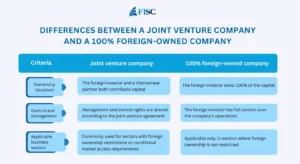
Foreign investors entering the Vietnamese market typically choose between two common business structures: a 100% foreign-owned company and a joint venture company with a Vietnamese partner. Each model offers distinct advantages and considerations depending on the investor’s industry, business objectives, and desired level of control.
When Should You Choose a 100% Foreign-Owned Company?
A 100% foreign-owned company may be the best option if you:
- Want full control over business operations and strategic decisions.
- Have experience operating businesses in international markets.
- Need to protect proprietary technology, processes, or intellectual property.
- Intend to invest in sectors that permit 100% foreign ownership.
When Should You Choose a Joint Venture Company?
A joint venture may be more suitable if you:
- Plan to invest in a sector that restricts foreign ownership or requires a Vietnamese partner.
- Want to benefit from an established local network, customer base, or market expertise.
- Prefer to share investment costs and business risks during the early stages.
- Need faster market entry through an existing local business ecosystem.
Ultimately, the right structure depends on your investment goals, industry regulations, and long-term business strategy in Vietnam.
Conditions for establishing a 100% foreign-owned company
Under the 2020 Investment Law and the 2020 Enterprise Law, foreign investors must satisfy the following requirements to legally establish a wholly foreign-owned company in Vietnam.
Foreign investors
Foreign investors may be either individuals or legal entities. Each category must meet specific legal requirements to ensure lawful investment activities.
For individuals
- Must have full legal capacity.
- Must not fall under any category prohibited from investing under Vietnamese law (e.g., individuals under criminal prosecution or involved in bankruptcy proceedings).
For organizations
- Must be legally established in their home country.
- Must have the legal right to conduct investment activities under the laws of their country of incorporation.
- Must not be restricted from making outbound investments.
Business sectors
To ensure eligibility for licensing, foreign investors should understand the market access conditions applicable to their intended business lines. Under Decree 31/2021/ND-CP, foreign investors should pay attention to conditional business sectors and sectors with restricted market access.
Conditional business sectors for foreign investors
Foreign investors may only participate if they meet specific conditions, such as restrictions on ownership ratios, investment forms, operational scope, or requirements to partner with a Vietnamese entity.
| Sector | Conditions |
| Telecommunications | Foreign ownership limited to 49% in enterprises with network infrastructure; joint venture with a Vietnamese partner required. |
| Goods distribution & retail | Business license required; opening a second retail outlet or more requires an Economic Needs Test (ENT). |
| Maritime transport, aviation & logistics | Ownership caps (typically up to 49%); requirements regarding Vietnamese crew members and legal representatives. |
| Banking, insurance & securities | Ownership restrictions apply (up to 30% in commercial banks; up to 49% in securities and insurance companies). |
| Education, private healthcare & professional services | Must satisfy requirements regarding facilities, professional qualifications, and approval from relevant authorities. |
Sectors closed to foreign investors
Foreign investors are prohibited from operating in certain sectors, including:
- Journalism and press activities
- Investigation and security services
- Fishing and seafood harvesting
- Judicial administrative services (appraisal, notarization, auction, insolvency administration)
- Overseas labor placement services
- Travel services (except international inbound tourism services)
- Manufacturing and trading of weapons, explosives, and military equipment
- Import-export, temporary import for re-export, and transshipment of restricted goods
- Maritime inspection, transportation safety, and specialized transport equipment services
- Forest exploitation and research into new livestock genetic resources
- And other restricted sectors as prescribed by law
Investment capital
Currently, there is no general minimum capital requirement for foreign investors. However, the investment capital must be appropriate for the business scale and sufficient to implement the project.
For certain regulated industries, a statutory capital requirement applies. For example, real estate businesses must have a minimum capital of VND 20 billion.
Procedures for establishing a 100% foreign-owned company
To ensure a smooth incorporation process, investors should prepare the required documentation and complete the following procedures.
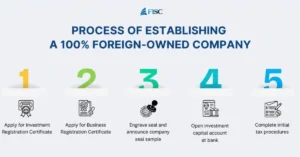
Step 1: Obtain an Investment Registration Certificate (IRC)
Under Article 37 of the 2020 Investment Law, all investment projects undertaken by foreign investors must obtain an Investment Registration Certificate (IRC) before implementation. This certificate confirms that the project is approved under Vietnamese law and serves as the basis for subsequent incorporation procedures.
IRC application dossier
- Application for issuance of an Investment Registration Certificate
- Certified copies of the investor’s legal documents (individual or corporate)
- Investment project proposal, including:
- Business activities
- Investment capital
- Project location
- Business plan
- Capital contribution schedule
- For conditional sectors: documents proving compliance with industry-specific requirements (statutory capital, professional qualifications, licenses, etc.)
Step 2: Obtain an Enterprise Registration Certificate (ERC)
After receiving the IRC, foreign investors must register for an Enterprise Registration Certificate (ERC) to officially establish the company in Vietnam.
ERC application dossier
- Enterprise registration application
- Company charter
- Legal documents of the investor
- Copy of the Investment Registration Certificate (IRC)
Step 3: Company seal registration
Once both the IRC and ERC have been issued, the company may proceed with seal engraving and publish its business registration information on the National Business Registration Portal.
This publication allows the company seal to be legally recognized for use in transactions, contracts, internal documentation, and dealings with government authorities.
Step 4: Open a bank account and contribute capital
Within 90 days from the issuance date of the Enterprise Registration Certificate, foreign investors must open a bank account in Vietnam and contribute the registered investment capital according to the schedule stated in the IRC.
This step demonstrates the company’s financial capacity and serves as the foundation for administrative procedures, international payments, and day-to-day operations.
Step 5: Complete tax and post-licensing procedures
In the final stage of the incorporation process, investors must complete initial tax registration procedures, including:
- Tax code registration
- Tax declarations
- Electronic invoice registration
In addition, foreign investors intending to live and work in Vietnam long-term should apply for a work permit and a temporary residence card (TRC).
If the company employs foreign staff, similar immigration and labor procedures must also be completed to ensure compliance with Vietnamese labor and immigration regulations.
Conclusion
Establishing a 100% foreign-owned company in Vietnam offers significant advantages in terms of management control and operational flexibility. However, investors must understand the applicable legal requirements, prepare comprehensive documentation, and comply with all licensing procedures to ensure a successful setup.
Due to language barriers and the complexity of Vietnamese regulations, foreign investors often face challenges during the licensing process. Therefore, engaging a reputable consulting firm can be essential for ensuring accuracy, efficiency, and compliance.
With 40 years of experience in foreign investment consulting, FISC has supported leading international corporations such as Red Bull, PepsiCo, and P&G. We provide comprehensive solutions and guide investors through every stage of establishing a 100% foreign-owned company in Vietnam.
Contact FISC today for professional consultation and take the first step toward a successful investment journey in Vietnam.
Frequently Asked Questions
Can foreign investors fully own a company in Vietnam?
Yes. Foreign investors may own 100% of a company in Vietnam, provided the business sector is not subject to market access restrictions.
For certain sectors such as logistics, education, or advertising, foreign ownership may be capped, or a joint venture with a Vietnamese partner may be required.
Is a registered office required when establishing a company?
Yes. A legally valid business address is mandatory when establishing a 100% foreign-owned company.
The registered office may be:
- A commercial office space
- A house used for both residential and business purposes
- A serviced office or virtual office
However, residential apartments without commercial functions cannot be used as a registered business address.
Can foreign investors repatriate profits overseas?
Yes. Foreign investors are permitted to transfer profits abroad provided that:
- The company has fulfilled all tax obligations
- Audited financial statements have been completed
- Profit remittance is conducted through the investment capital account in accordance with regulations issued by the State Bank of Vietnam