

Establishing a foreign joint venture company is a strategic step to invest in Vietnam, allowing international investors to leverage local market opportunities and resources. However, legal procedures, capital contribution registration, and corporate management can be complex, especially for investors launching a joint venture project for the first time.
Understanding the establishment process helps minimize risks, reduce costs, and bring the business into operation more quickly. It also enables investors to determine capital contribution ratios, rights, and obligations of each party, creating a solid foundation for long-term cooperation.
This article provides a detailed guide to establishing a foreign-invested joint venture company in Vietnam, from choosing the appropriate business structure and preparing application documents to obtaining licenses and operating the company after establishment.
What is a foreign joint venture company?
As one of the most common forms of foreign direct investment in Vietnam, a foreign joint venture company is a business entity established through cooperation between a foreign investor and a Vietnamese partner. Under this model, the parties contribute capital, share profits, and assume risks according to an agreed ratio. The participants may be individuals or organizations.
Example: A Vietnamese company partners with a Japanese company to establish a manufacturing plant in Vietnam.
Key characteristics
- At least two parties participate in the venture.
- The parties contribute capital and share profits and risks.
- The company is jointly managed according to the terms of the joint venture agreement.
Although both are forms of foreign-invested enterprises, a joint venture differs from a 100% foreign-owned company in terms of ownership structure and control rights.
A joint venture is established by a foreign investor and a Vietnamese partner, with both parties contributing capital and sharing profits and risks based on mutual agreement. In contrast, a wholly foreign-owned company is entirely owned and controlled by foreign investors, but this structure is only available in sectors without foreign ownership restrictions.
After contributing capital to a joint venture company, a foreign investor may be eligible for an investor visa with a validity of up to five years, depending on the investor’s ownership ratio, investment capital amount, and the applicable legal regulations.
When should you choose a foreign joint venture company?
When investing in Vietnam, foreign investors must select a business structure that aligns with their objectives and legal requirements. In many cases, establishing a joint venture company is both an effective and strategic option.
Industries restricted for foreign investors
In certain sectors in Vietnam, foreign investors are not permitted to own 100% of the capital or must satisfy specific foreign ownership conditions.
According to Appendix I of Decree No. 31/2021/ND-CP, which governs conditions for foreign investment in Vietnam, sectors subject to market access conditions for foreign investors include real estate, telecommunications services, air transportation, banking and other regulated industries.
In these cases, partnering with a Vietnamese company through a joint venture not only helps meet legal requirements but may also be necessary to obtain the relevant operating licenses.
Need for local market knowledge or networks
For investors entering Vietnam for the first time, limited understanding of customer behavior, business culture, and distribution systems can create significant challenges.
A joint venture with a local company provides immediate access to operational experience, established business relationships, distribution & sales channels and in-depth market knowledge
This can shorten market-entry timelines and improve the likelihood of success.
Sharing investment risks and costs
Large-scale projects often require substantial capital and involve long investment recovery periods. Managing such projects independently can expose investors to significant financial and operational risks.
A joint venture allows the parties to share initial investment costs, allocate operational risks, reduce financial pressure and improve investment security.
Long-term development goals in Vietnam
For foreign investors planning long-term operations in Vietnam, a joint venture can help build sustainable partnerships with local businesses.
In addition, the participation of a Vietnamese partner may facilitate licensing procedures, communication with government authorities and access to investment incentives
Note:
- If a foreign company only intends to research the Vietnamese market, seek partners, conduct trade promotion activities, or supervise its parent company’s operations without directly generating revenue, establishing a representative office may be a more suitable option because it reduces costs and simplifies legal procedures.
- For companies that already have a legal entity abroad and wish to conduct revenue-generating business activities in Vietnam without establishing a new legal entity, setting up a branch office may be a practical and effective solution.
Types of foreign joint venture companies
Foreign-invested joint ventures can be organized in different forms depending on business needs, desired control levels, and legal requirements.
Joint venture limited liability company (LLC)
This is the most common form of joint venture. It is established through capital contributions from at least one domestic investor and one foreign investor.
Key features include:
– Liability limited to each party’s contributed capital.
– Separate legal entity status.
– Operations governed by Vietnamese law.
– Typically managed through a Members’ Council and a Director/General Director.
– Management rights and profit distribution are determined according to each party’s capital contribution ratio.
Joint venture joint stock company (JSC)
Under this structure, investors contribute capital through share ownership.
Key features include:
– Shareholders may transfer shares in accordance with the law and company charter.
– Separate legal entity status.
– Corporate structure consisting of:
- General Meeting of Shareholders- Board of Directors
- Supervisory Board (if applicable)
- Executive Management
This model is suitable for businesses requiring significant capital mobilization or involving multiple investors.
Joint ventures established under agreements or cooperation contracts
Some joint ventures are formed under government agreements or cooperation arrangements with international organizations. These ventures typically operate in strategic sectors such as oil, gas, natural resource exploitation or telecommunications. They are often associated with long-term cooperation objectives between the participating parties.
Conditions for establishing a foreign-invested joint venture company
To establish a foreign joint venture company in Vietnam, both domestic and foreign investors must satisfy certain legal requirements to ensure transparent and compliant business operations.
Contributing parties
- Individual investors: Must have full legal capacity, must not be serving a prison sentence, and must not be subject to administrative sanctions that restrict investment activities under Vietnamese law.
- Foreign organizational investors: Must be legally established entities and be lawfully operating at the time of making an investment or capital contribution in Vietnam.
Capital requirements
- Each joint venture participant is legally responsible only for the amount of capital it commits to contribute and must demonstrate financial capacity corresponding to the registered investment amount.
- The charter capital of a joint venture company must account for at least 30% of the total investment capital.
- For projects located in encouraged investment areas or sectors, the ratio may be lower but cannot be less than 20%, subject to approval by the competent authority.
- Depending on the business sector, the company must register a charter capital level appropriate to the project’s scale and comply with Vietnamese regulations.
Business line requirements
A joint venture company may only register business activities permitted under Vietnamese law. It may not engage in sectors subject to foreign market access restrictions under Decree No. 31/2021/ND-CP.
Procedures for establishing a foreign joint venture company
Establishing a joint venture company is an important step to ensure that an investment project in Vietnam operates legally and effectively. There are currently two common methods:
Method 1: Establishing a joint venture company directly with foreign investor capital
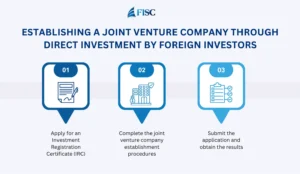
Under this method, the company will be granted both an Investment Registration Certificate (IRC) and an Enterprise Registration Certificate (ERC).
Step 1: Apply for the investment registration certificate
The application dossier for obtaining the investment registration certificate includes:
- Investment project proposal
- Written request for implementation of the investment project
- Copy of the lease agreement for the company’s registered office. If the premises are subleased from another company, a copy of the lessor’s Enterprise Registration Certificate showing a registered real estate business line must also be provided.
- Notarized copies of legal documents of both Vietnamese and foreign investors
*For individual investors
- Passport
- Bank account balance confirmation showing financial capacity equal to or greater than the amount committed for the project (applicable to both domestic and foreign investors)
*For organizational investors
- Business registration certificate
- Passport of the organization’s authorized capital representative
- Audited financial statements for the most recent fiscal year or equivalent financial documents
*Note: Documents issued overseas must be translated into Vietnamese, notarized, and consular legalized by the Vietnamese diplomatic mission in the country where the documents were issued in accordance with applicable regulations.
After preparing the required documents, the investor submits the application to the Investment Division of the Department of Finance (formerly the Department of Planning and Investment) in the province or city where the joint venture company is expected to be headquartered.
Within 15 working days from the date of receipt of a complete and valid application, the authority will review the dossier and issue the IRC for the joint venture company.
Step 2: Register the joint venture company
The application dossier includes:
- Company charter
- Enterprise registration application
- List of members (for a multi-member LLC) or list of founding shareholders (for a joint stock company)
*For corporate investors
- Authorization letter appointing a representative to manage the contributed capital
- Copy of the legal identification document (passport) of the legal representative of the joint venture company
- Copy of the business registration certificate
*For individual investors
- Copy of legal identification documents (passport)
Step 3: Submit the application and obtain the enterprise registration certificate
After preparing the required documents, the legal representative may submit the application directly to the Business Registration Office under the Department of Finance where the company’s head office is located or submit online through the National Business Registration Portal.
Online submission is now common in major localities such as Hanoi, Ho Chi Minh City, and Binh Duong.
Within 3–5 working days from receipt of a complete and valid application, the Business Registration Office will issue the enterprise registration certificate.
Method 2: Establishing a joint venture through capital contribution or acquisition of shares/capital in a Vietnamese company
Under this method, the joint venture company will only receive the enterprise registration certificate and will not be granted the investment registration certificate.
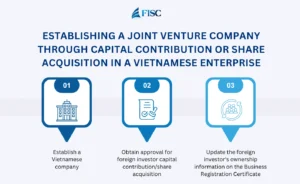
Step 1: Establish a Vietnamese company with 100% Vietnamese capital
The application dossier includes:
- Company charter
- Enterprise registration application
- List of members (for a multi-member LLC) or founding shareholders (for a joint stock company)
- Copy of the business registration certificate of organizational members/shareholders
- Copy of the legal representative’s identification documents (Vietnamese identity card or passport)
- Authorization letter appointing a representative to manage the Vietnamese organization’s contributed capital
After preparing the documents, the application can be submitted online through the National Business Registration portal or directly to the Business Registration Office of the Department of Finance.
Within 3–5 working days from receipt of a valid application, the authority will issue the ERC.
Step 2: Obtain approval for foreign investor capital contribution
Required documents include:
- Copy of the Vietnamese company’s enterprise registration certificate
- Application for capital contribution or share acquisition by the foreign investor
- Capital contribution or share purchase agreement between the Vietnamese company and the foreign investor
*For corporate investors
- Notarized copy of the Business Registration Certificate (consular legalized and translated into Vietnamese)
*For individual investors
- Notarized copy of the passport
Once completed, the dossier is submitted to the Investment Division of the Department of Finance where the company is headquartered.
Within 10 working days from receiving a valid application, the authority will issue a written confirmation approving the foreign investor’s capital contribution or share acquisition.
Step 3: Update shareholder or member information on the enterprise registration certificate
At this stage, the Vietnamese company and the foreign investor sign a capital transfer or share transfer agreement.
The company then files for amendment of its enterprise registration information to reflect the foreign investor’s participation.
Required documents:
- Original approval letter for foreign investor capital contribution/share acquisition obtained in Step 2
- Capital transfer/share transfer agreement and liquidation minutes
- Authorization letter appointing representatives for the foreign organization’s contributed capital, together with the list of authorized representatives
- List of foreign shareholders (for joint stock companies)
- Updated list of members or shareholders after completion of the transfer
*For individual foreign investors
- Notarized copy of the foreign investor’s passport
*For corporate foreign investors
- Copy of the foreign investor’s Business Registration Certificate
- Copy of the passport of the organization’s authorized capital representative
After the dossier is completed, the company submits it online through the National Business Registration Portal.
Within 5–7 working days from receipt of a valid application, the Business Registration Office will review the application and issue a new Enterprise Registration Certificate reflecting the updated ownership structure.
Professional and reliable foreign joint venture company formation services
Establishing a foreign-invested joint venture company is a strategic solution that allows foreign investors and Vietnamese businesses to combine their strengths, share risks, and unlock new growth opportunities. To ensure the project operates legally, efficiently, and sustainably, selecting the right joint venture structure and preparing a complete application dossier are critical factors.
Throughout this process, FISC supports investors from the initial consultation stage through legal procedures and post-establishment compliance, helping companies commence operations quickly and securely. With more than 40 years of experience, FISC has assisted major businesses such as Red Bull, VSIP, and Mercedes in successfully implementing joint venture projects in Vietnam.
Contact FISC today for professional advice and tailored support for your investment project.
Frequently Asked Questions
Does Vietnamese law regulate the capital contribution ratio between foreign and Vietnamese investors in a joint venture company?
Under Vietnamese law, there is no fixed capital contribution ratio that applies to all joint venture companies. The ownership ratio between foreign investors and Vietnamese investors is generally determined through mutual agreement in the joint venture contract.
However, certain sectors are subject to foreign ownership restrictions, including maximum or minimum ownership thresholds. Examples include road freight transportation (maximum 51% foreign ownership), telecommunications services without network infrastructure (maximum 65%), road passenger transportation (maximum 49%), and certain agricultural sectors (maximum 51%).
Can the capital contribution ratio be changed after the company is established?
Yes. The capital contribution ratio can be changed after the company is established. However, the company must complete the necessary procedures to amend its ownership structure with the Department of Finance (formerly the Department of Planning and Investment) and update the joint venture agreement accordingly.
For business sectors that impose foreign ownership restrictions, any change in ownership must comply with the applicable maximum or minimum limits. If the proposed ownership structure exceeds these thresholds, additional approval from the relevant regulatory authority may be required.
Can shares be transferred between foreign investors in a joint venture company?
Yes. Shares or capital contributions may be transferred between foreign investors in a joint venture company. However, the transfer must comply with the provisions of the joint venture agreement and the company charter, and the company must complete the required procedures to update its registration records with the competent licensing authority.
Can a joint venture company hire foreign employees?
Yes. A joint venture company in Vietnam can hire foreign employees if it meets the requirements under Vietnamese law. In this case, the company needs to complete relevant procedures such as applying for a work permit and a temporary residence card for foreign employees.