
When you are living or working in Vietnam, one date you cannot afford to overlook is your visa expiry date.The in-country visa extension process doesn’t always go through in time or without a hitch.
When your remaining stay is down to a matter of days, a Vietnam visa run is the most common and practical way to reset your stay and stay legal.
So, what exactly is a visa run and how does the process work? Here’s everything you need to plan a safe, smooth border run and get back into Vietnam without stress.
What is a visa run in Vietnam?
A Vietnam visa run means leaving the country before your current permitted stay expires, travelling to another country (usually Laos, Cambodia, Thailand, or China) and then re-entering Vietnam with a new visa or entry document to begin a new period of stay.
How a visa run differs from an official visa extension
A visa extension is completed while you are still in Vietnam. Your application is submitted to the immigration authority and, if approved, your existing period of stay is extended without requiring you to leave the country.
A visa run works differently. You must physically exit Vietnam and then re-enter using a valid visa or other eligible entry document to receive a new permitted period of stay.
When do you need a Vietnam visa run?
You may consider a visa run in the following situations:
- You are not eligible to extend your stay from inside Vietnam: Certain entry documents, such as an e-visa, a 5-year visa exemption certificate, or a 45-day visa-exempt stay, may not be directly extended in Vietnam.
- You are waiting for your work permit or temporary residence card: If your work permit or temporary residence card is still being processed but your current visa is close to expiry, a visa run may serve as a temporary solution while you wait for the long-term immigration procedure to be completed.
- You need to enter Vietnam under a different visa purpose: Depending on your immigration status and the visa type you need, you may have to leave Vietnam and re-enter using the correct entry document before proceeding with a work visa or temporary residence card.
If you plan to work and stay in Vietnam for 6 months or longer, repeated visa runs are not a suitable long-term immigration solution. Under Decree 152/2020/ND-CP, if you work in Vietnam for more than 90 days, your employer is required to apply for a work permit so you can switch to a work visa or a temporary residence card valid for up to 2 years.
Common types of Vietnam visa run
Depending on your budget, available time, and current location, you can generally choose between two options.
Visa run by air
For an air visa run, you book a short round-trip flight from an international airport (Tan Son Nhat, Noi Bai, or Da Nang) to a nearby country such as Thailand, Malaysia, or Singapore.
Depending on your travel plans, you may fly back to Vietnam on the same day or combine the trip with a short holiday before returning.
When you re-enter at a major airport, adding an airport fast-track service is a great way to skip the tiring queues at the processing counter and make the whole thing far quicker and smoother.
Below is a list of international airports you may use:
| Airport | Province / City |
| Noi Bai | Hanoi |
| Tan Son Nhat | Ho Chi Minh City |
| Da Nang | Da Nang |
| Cat Bi | Hai Phong |
| Cam Ranh | Khanh Hoa |
| Phu Quoc | An Giang |
| Can Tho | Can Tho |
Visa run by land (border run)
A land visa run is usually the more budget-friendly option. You can travel by coach or private car to an international land border crossing, exit Vietnam, enter the neighbouring country, and then return to Vietnam.
Common international border crossings include:
| Border | Crossing | Province / City |
| Laos (10 crossings)
|
Tay Trang | Dien Bien |
| Na Meo | Thanh Hoa | |
| Nam Can | Nghe An | |
| Cau Treo | Ha Tinh | |
| Cha Lo | Quang Tri
|
|
| La Lay | ||
| Lao Bao | ||
| Bo Y | Quang Ngai | |
| Long Sap | Son La | |
| Nam Giang | Da Nang | |
| Cambodia (10 crossings)
|
Moc Bai | Tay Ninh
|
| Xa Mat | ||
| Tan Nam | ||
| Binh Hiep | ||
| Tinh Bien | An Giang
|
|
| Ha Tien | ||
| Vinh Xuong (Song Tien) | ||
| Le Thanh | Gia Lai | |
| Thuong Phuoc | Dong Thap
|
|
| Dinh Ba | ||
| China (5 crossings)
|
Mong Cai | Quang Ninh |
| Huu Nghi | Lang Son | |
| Lao Cai | Lao Cai | |
| Tra Linh | Cao Bang | |
| Thanh Thuy | Tuyen Quang |
The most cost-effective crossings by region:
- If you’re in Hanoi / the North: a visa run by air from Noi Bai to Thailand, Malaysia, or Singapore is usually best, since there’s no land crossing very close to the center.
- If you’re in Ho Chi Minh City / the South: the Moc Bai crossing (Tay Ninh) is the most popular and cheapest option, only about 2–3 hours away.
- If you’re in Central Vietnam: the Lao Bao crossing (Quang Tri) is convenient if you’re in Hue, Da Nang, or Quang Nam.
- If you’re in the Mekong Delta: the Ha Tien or Tinh Bien crossing (An Giang) is your nearest option.
Although there are many international land crossings, not all are practical for a same-day visa run. For a smoother journey, you should prioritise crossings with more established coach, shuttle, or private transport services, such as Moc Bai, Lao Bao, Ha Tien, Mong Cai, Lao Cai, and Huu Nghi.
Vietnam visa run process
To avoid unnecessary problems at the border, you should prepare carefully and complete the process in the correct order.
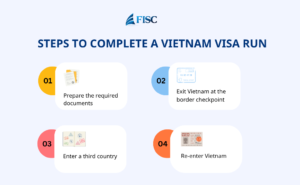
Step 1: Prepare your documents
Before leaving Vietnam, carefully check that you have the following documents:
- Your original passport: It should be valid for at least 6 months from your intended re-entry date and have at least 2 blank pages for immigration stamps.
- A valid document for re-entering Vietnam: This may be an e-visa or a 5-year visa exemption certificate, depending on your immigration status.
- Entry documents for the country you are travelling to: Check whether your nationality is visa-exempt for Laos, Cambodia, Thailand, or your chosen destination. If a visa is required, make sure you obtain it in advance or confirm whether a visa on arrival is available.
Step 2: Complete exit formalities at the Vietnamese border
At the international airport or land border crossing, present your passport and any required documents to the Vietnamese immigration officer.
Once your exit formalities are completed, your passport will be stamped to confirm that you have officially left Vietnam.
Step 3: Enter the third country
Head to the neighboring country’s crossing or airport and complete entry formalities under its local rules (via visa exemption, a pre-arranged e-visa, or a visa on arrival). After completing the entry process, you may return towards Vietnam on the same day or stay in the country for a short trip before travelling back.
Step 4: Re-enter Vietnam
When returning to Vietnam, present your passport and the valid entry document. Once the information matches, the immigration officer stamps your entry and grants you a new period of stay.
FAQs
Is a Vietnam visa run legal?
A visa run isn’t prohibited, but Vietnamese law doesn’t recognize it as an official form of visa extension either. Under Law No. 47/2014/QH13 (amended by Law No. 51/2019/QH14) and Decree 144/2021/ND-CP, it’s only valid if you exit on time and re-enter with a new visa, used for the exact purpose you registered.
How soon can I re-enter Vietnam after a visa run?
It depends on the new visa you get. If you re-enter on an e-visa, you can be back in Vietnam as soon as about 2 hours after you complete your exit formalities. If you need an urgent e-visa to re-enter the same day, contact FISC right away for express handling.
Roughly how much does a Vietnam visa run cost?
The cost depends on whether you travel by land or air, your chosen destination, and the type of visa or entry document you need.
Your total expenses may include transport or airfare, visa fees for the third country, Vietnam visa costs, accommodation, and other travel expenses.
A single land border run may be relatively affordable, but repeatedly completing visa runs can become more expensive and inconvenient than arranging the correct long-term immigration status.
Which crossing is fastest for a visa run from HCMC, Hanoi, or Da Nang?
If you are in Ho Chi Minh City, Moc Bai border crossing in Tay Ninh is one of the most popular choices because it is relatively close and a round trip can usually be arranged within the same day.
From Da Nang, Lao Bao border crossing in Quang Tri may be a convenient land route.
If you are in Hanoi, an air visa run is often more practical because there is no major international land crossing close to the city centre.
Conclusion
When your visa is about to expire and the domestic extension process can’t keep up, a Vietnam visa run provides a practical short-term solution to avoid overstaying and maintain your lawful immigration status.
However, the correct visa run route depends on your current visa, nationality, reason for staying in Vietnam, and the type of entry document you will use to return.
With more than 40 years of experience, FISC provides an all-inclusive visa run service, from checking the appropriate visa type and preparing your entry documents to assisting with exit and re-entry procedures at the border.
Contact FISC today for a free consultation.